Full restoration of the upper and lower jaw with implants
A fixed restoration for severely broken and missing teeth, remaining roots, and a deep bite that had limited chewing mainly to the front teeth.

Before

After
The clinical case in brief
The patient was looking for a fixed solution for severely broken and missing teeth, remaining roots and a very deep bite. After a clinical examination, bite analysis, photographic records and computed tomography, single-stage treatment was carried out with basal implants and directly fabricated permanent bridge restorations.
Scope
Upper and lower jaw
Method
Basal implants
Implants
10 in the upper jaw · 8 in the lower jaw
Timeframe in this case
Monday–Friday
Initial condition
Teeth missing for years, severely broken and compromised teeth, and remaining roots. The absence of teeth in the chewing areas had led to eating mainly on the front teeth. A deep bite was also found, with a functional and aesthetic problem.
Diagnosis
A clinical examination, bite analysis, photographic records and computed tomography were carried out.
Imaging records
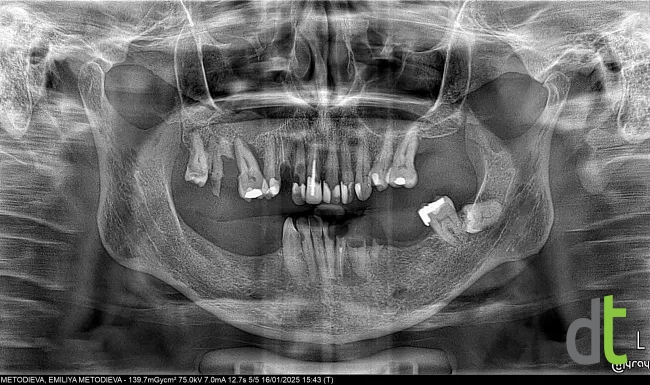
Before
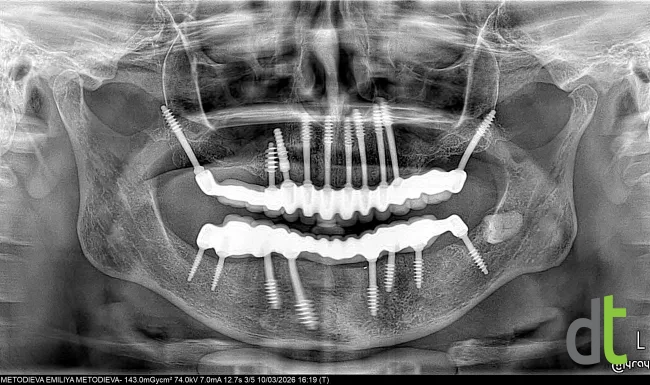
After
Individual plan
Chosen plan
Extraction of the teeth with no useful prognosis and of the remaining roots, bone reshaping in the upper and lower front, 10 basal implants in the upper jaw and 8 in the lower jaw, and direct fabrication of permanent metal-ceramic bridge restorations. Provisional restorations were not used in this case.
Why this approach
The remaining teeth were loose and had no useful prognosis, and the deep bite required a change in the height and distribution of the load. Basal implants were chosen for cortical anchorage, primary stability, and the possibility of organising the treatment in a single stage.
Stages
The Monday-to-Friday timeframe is specific to this case.
Result
Chewing function in the posterior areas was restored. The bite was raised and a fixed support was created for both jaws. A natural smile was achieved, with an improvement in function, appearance and the patient’s confidence.
Important: The method, the number of implants, the restoration, the timeframe and the result are individual and are determined after an examination and imaging.
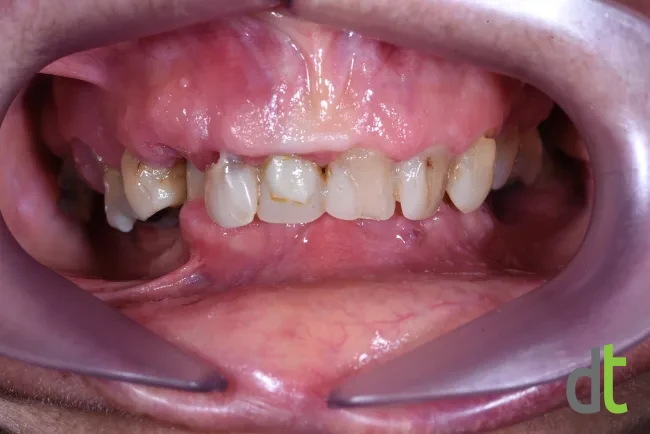
Before
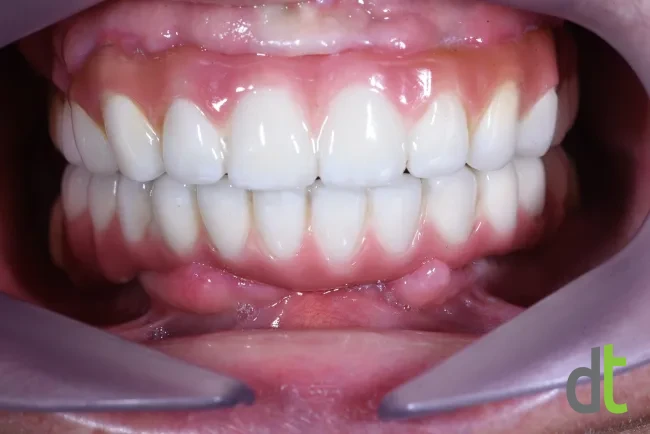
After
Clinician’s comment
Anchorage of the implants in the cortical zones, stability, and precise raising of the bite were decisive for treatment in this case. We did not use provisional restorations, because we planned single-stage treatment and the patient had a strong fear of procedures. Under conscious sedation the teeth with no useful prognosis were removed, bone reshaping was carried out and the implants were placed. At the end of the surgical stage we took an impression. Precise determination of the new bite, and work with an experienced dental technician, played an essential role. The final result is restored function, appearance and confidence.
Common questions
Because of the condition of the loose teeth with no useful prognosis, the need to change the bite, and the primary stability sought through cortical anchorage.
In this specific case, single-stage treatment was planned, with direct fabrication of permanent bridges. This is not a required approach for every patient.
No. This is the actual timeframe in this case. The duration depends on the clinical condition and the individual plan.
It was used for better control of anxiety during the surgical stage. The approach is determined individually.
Do you need a full restoration of the bite?
The first step is a clinical examination and imaging.
The method, the number of implants, the restoration, the timeframe and the result are individual and are determined after an examination and imaging.