Complex treatment with implants in the upper jaw and a combined restoration on teeth and implants in the lower jaw
The patient sought a solution for displacement of the upper front teeth, a widening space between them, and missing chewing teeth in the upper jaw. After complex diagnosis, a radical implant restoration of the upper jaw and combined treatment of the lower jaw were carried out, preserving the teeth with a suitable prognosis.

Before

After
Key facts
Scope
Upper and lower jaw
Method
Basal implants in the upper jaw and combined treatment in the lower jaw
Implants
12 in the upper jaw · 2 in the lower jaw
Actual timeframe
Several consecutive stages
Initial condition
Missing teeth, periodontal changes around the remaining teeth, bone loss, and teeth with no prospect of successful retreatment were found. The patient smokes, which was taken into account in the risk assessment, the planning and the later follow-up.
Diagnosis
A clinical examination, bite analysis and computed tomography were carried out. Bone volume, the condition and prognosis of the remaining teeth, the position of the missing chewing teeth, and the need to restore proper contacts were assessed.
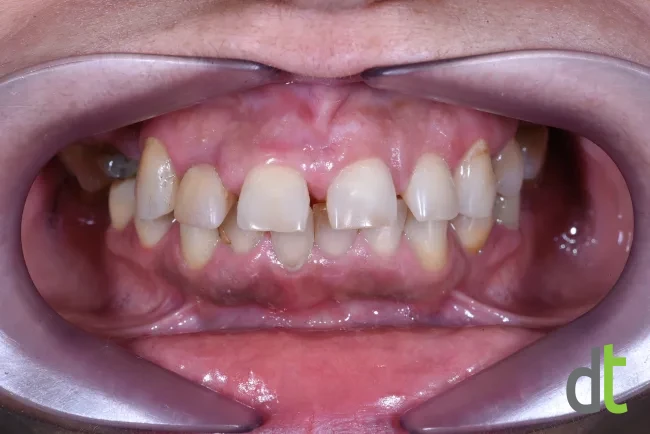
Intraoral condition before treatment
Imaging and follow-up
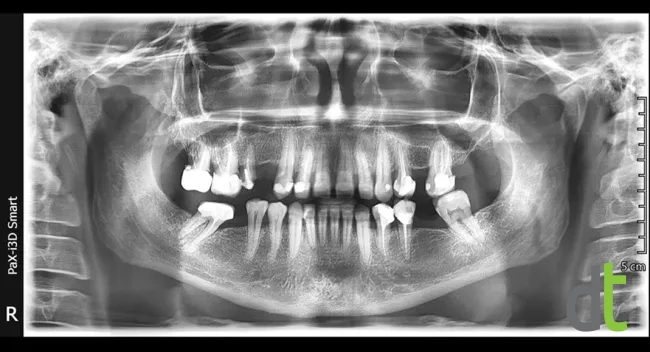
Before
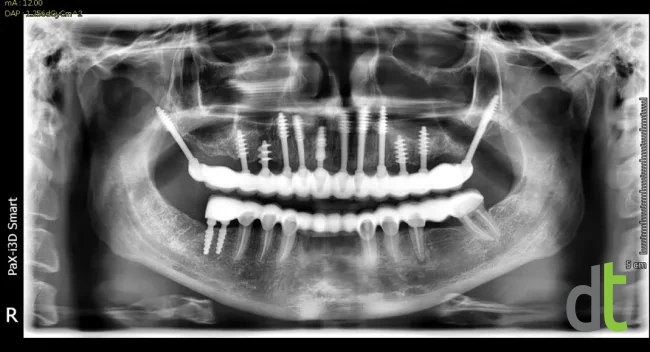
After
Individual plan
Chosen approach
In the upper jaw a radical plan was applied, with extraction of the compromised teeth, placement of 12 basal implants, and fabrication first of a provisional acrylic bridge and, after the healing period, of a final metal-ceramic fixed restoration. In the lower jaw the teeth with a suitable prognosis were preserved, the necessary treatment was carried out, and 2 implants were placed on the right in the area of the first molar, with a provisional bridge on teeth and implants. The final lower restoration combines support on natural teeth and implants.
Why this method?
Because of the periodontal problems, the lack of sufficient bone volume and the need for partial extractions, a combined plan was chosen. The basal implants in the upper jaw allowed support in the available stable bone zones, and preserving the suitable lower teeth avoided unnecessarily radical treatment. The provisional restorations made it possible to raise and refine the bite before the permanent restorations were made.
Stages
The timeframes are the real ones for this specific case and are determined individually.
Result
A fixed bite was restored, with the contacts in the molar area raised and stabilised. A functional and aesthetic restoration of both jaws was achieved, with a permanent restoration on implants only in the upper jaw and a combined restoration on teeth and implants in the lower jaw.
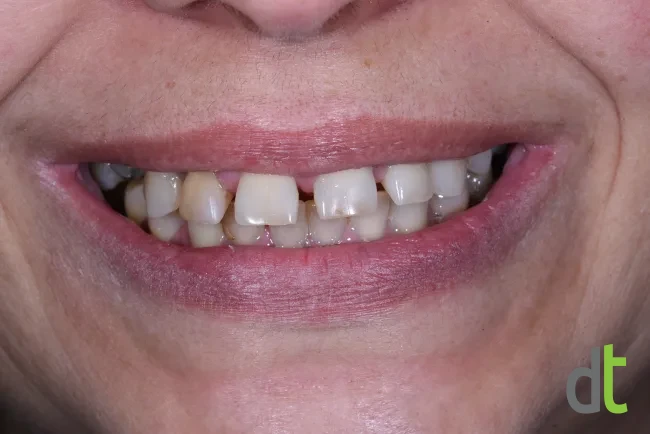
Before
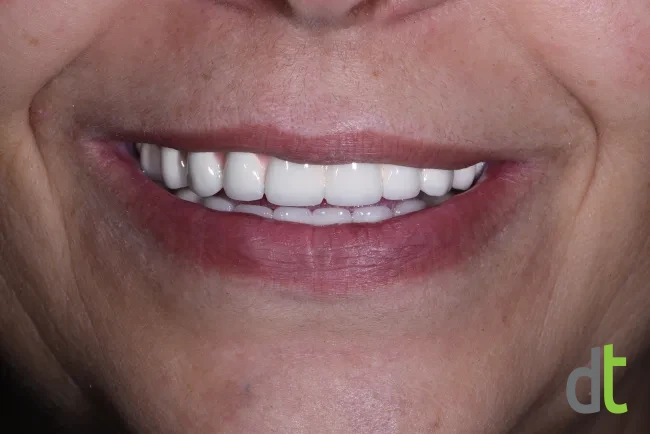
After
Before
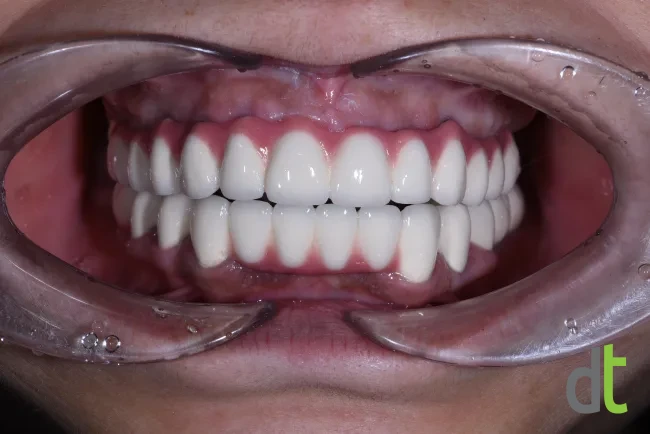
After
Note from the treating dentist
In this case we combined basal implants in the upper jaw with a partial prosthetic restoration on teeth and implants in the lower jaw. Bone loss and displacement of the upper front teeth required raising of the bite and careful restoration of the proper contacts. In the lower jaw we placed implants only in the necessary right chewing area and preserved the teeth with a suitable prognosis. The provisional restorations allowed us to refine the height and the contacts before we made the permanent metal-ceramic restorations. The period without fixed teeth was thus limited to a few days, and the final result was planned for function and appearance together.
Common questions
The choice is related to the bone loss, the periodontal changes and the need for stable fixed support. The decision was made after a clinical examination and three-dimensional imaging.
The teeth with a suitable prognosis were preserved. Implants were added only where they were needed to restore support and proper chewing contacts.
Yes. There are cases, however, in which the timeframe depends on primary stability, the extent of treatment and the individual clinical plan.
Smoking is a risk factor that has a negative effect on the patient’s health and is taken into account in planning, healing and maintenance. The individual risk is discussed with the treating team, but with this type of dental implant the effect of nicotine is not a significant factor in the success of treatment.
Are you looking for an individual fixed solution?
The right plan is determined after a clinical examination and imaging.
Outcomes, timeframes, and the approach are individual.